
How to uncover the truth about ERP systems for furniture manufacturers? Save your spot on our webinar.
ERP Software for Furniture Manufacturers
See how furniture manufacturers use Infor ERP to quote configured orders, control multi-level BOMs and hit ship dates. Talk to an ERP advisor
What an ERP for furniture manufacturing has to handle
An ERP for furniture manufacturing ties four things into one system: configured quoting, multi-level bills of material that hold every fabric and finish option, mixed-mode production across your own plants and your subcontractors, and shop floor scheduling you can promise dates against.
Variant explosion.
Options multiply faster than any spreadsheet can track. Without a configurator tied to the BOM, someone is maintaining option lists by hand and pricing from memory.
Quote rework and configuration errors.
Options multiply faster than any spreadsheet can track. Without a configurator tied to the BOM, someone is maintaining option lists by hand and pricing from memory.
Material yield.
Timber, sheet goods, fabric and leather all get cut, and offcuts either get tracked or get thrown away. Actual yield against theoretical is one of the few numbers that moves margin directly.
Subcontract operations.
Finishing, upholstery and hardware often sit outside the system entirely, which means work in progress disappears for days at a time.
Promise dates.
Sales commits a ship date, the floor finds out later whether it was possible.
What Infor CloudSuite Industrial ERP does for furniture makers?
Designed specifically for companies that manufacture furniture for homes, offices, hotels, and public venues, along with retail fixtures and fittings. Manage a mix of configurable items, custom orders, and varied production approaches. Keep track of changing materials, finishes, fabrics, and design updates. Respond to increasingly short product cycles, coordinate outsourced work, and bring orders, production, and costs together in one unified platform.
Configured quoting with Infor CPQ
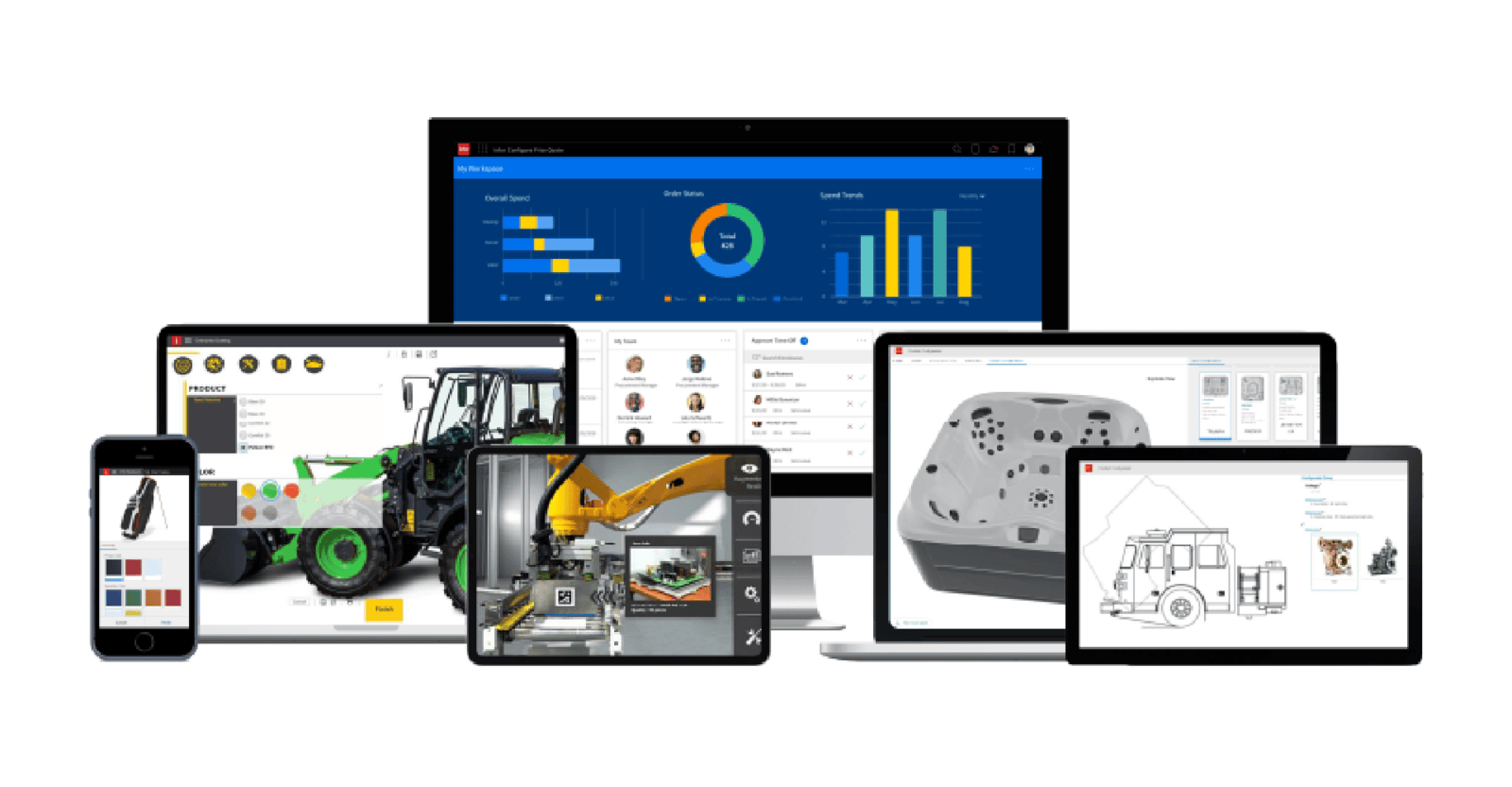
Dealers and customers configure their own orders through a guided interface, with 2D and 3D visuals so they see what they are buying. The estimated BOM that comes out of the configurator converts into a production order without anyone retyping it.
Multi-level BOMs for options, dimensions and finishes
Hold options, dimensions, finishes and alternates in structured BOMs with version control, so a fabric discontinuation or a hardware substitution is a controlled change rather than a scramble. Alternate materials and alternate routings are part of the record, not a note in someone's inbox.
Mixed-mode production: ETO, MTO, CTO and repetitive
Engineer-to-order, make-to-order, configure-to-order and repetitive production run in one system, across multiple sites, subcontractors and suppliers. High volume and low mix on one line, low volume and high mix on the next, without splitting operations across two systems as complexity grows.
Scheduling and shop floor throughput
Scheduling built to maximise throughput, with real-time labour capture and quality assurance integrated into the same transactions. Work in progress is visible while it is still in progress.
Dealer portals and ecommerce
Integrated dealer web portals with self-guided configuration and quoting used to be a differentiator. They are now the baseline expectation for anyone selling through a dealer network. Orders arrive configured, priced and clean.
Warranty, repair and aftermarket service
Warranty claims, repairs and field service are part of the ERP rather than a separate spreadsheet, so aftermarket cost per unit is a number you can actually see.
Alerts, AI and machine learning
Embedded monitoring and alerts flag the exceptions worth looking at — a late supplier, a job trending over standard, a stock position about to bite. The point is a shorter gap between something going wrong and someone knowing.
ERP by material and segment
Species, grade and sheet goods tracked through cutting, machining and finishing, with yield measured against theoretical rather than assumed. Finishing queues are usually the constraint, and scheduling has to treat them that way.
Fabric and leather inventory behaves differently from board and hardware. Rolls, hides, dye lots and cut-and-sew operations all need their own handling, and frame subassemblies have to stay in step with the cut-and-sew schedule. Smith Brothers and Palliser both run Infor.
Weldments, powder coating and fabrication routings alongside assembly. If your furniture business also does fabrication work, the same system covers both.
Moulding cycles, tooling and sharply seasonal demand. Grosfillex, a manufacturer of high-end outdoor resin furniture, runs Infor and has been adding automation and AI to processes that used to be manual.
Project-based orders behave differently again: submittals, phased installs, multi-site rollouts and long revision cycles before anything gets built. Workrite Ergonomics and The Worden Group are both in this space.
Personalization for Unique Furniture Orders
Syteline's configurator allows for personalization to fit Smith Brothers' unique business flows, and
it will streamline order entry-huge selling points for us.
- Scott Hollowell, IT Director, Smith Brothers
Infor Did What Promised
The planning, implementation, and post lunch experience have all met or exceeded our expectations. Infor did what they said they were going to do. They listened, studied, planned, and delivered what we asked for and needed.
Lesley Ransley, Workrite Ergonomics
Infor Allowed A Better Understanding for Growing Opportunities
CloudSuite has allowed us to grow substantially this year without significance increase in resources, and managing customers through the opportunities module (Infor CRM) is allowing us to see a clear picture of our Sales funnel and help us understand areas where can we grow.
- Kyle Meyers, Master/Scheduler ERP Administrator, The Worden Group
Outstanding ERP Implementation with Experienced ESS Implementation Team
I was very impressed with the Essential Software Solutions' teams responsiveness when we lost our existing ERP system. We quickly jumped on a call with the entire ESS crew who have been involved in our project and made a game plan of what we needed to get done to emergency go-live.
- Daniel Marshall, Vice President of Whittier Wood Furniture
What an AI-powered ERP changes for furniture and fixtures?
Fewer moving parts to manage.
Custom work, standard assembly runs and outsourced finishing all live in the same system instead of three. There is one version of what has been ordered, what has been built and what is out at a subcontractor, so nobody is reconciling by email when demand changes.
Real-time costs visibility.
Labour, materials, subcontract charges and finished product cost are visible per job, on custom and assembly-based work alike. That is what makes quoting accurate, and accurate quoting is what holds a margin when material prices move.
Ship dates you can stand behind.
Orders, materials and capacity are planned against each other rather than in sequence, so promised dates reflect what the floor can actually do. When something slips, the effect on downstream orders shows up early enough to act on.
New products out the door faster.
New lines, new materials and new design variations can be introduced more often without stalling current production, which matters when a fabric range changes or a dealer asks for something the catalogue does not cover yet.
Do you need a non-complex customization solution for your customers or dealers?
Showcase visuals developed by your engineers to customers and allow easy customizations.
Infor CPQ, with its supported 2D and 3D modelling, allows your customer to see the product they will get while reducing the amount of communication time of your salespeople.
A Few Examples of Furniture Manufacturers Using Infor ERP





Evaluate ERP Systems for Furniture Manufacturers
Frequently Asked Questions
Related Articles


Talk with an ERP advisor
Do you have questions about ERP selection, ERP implementation, ERP trainings or any other issues with digital transformation? Talk with one of our advisor, we'd be glad to help you.
Don't hesitate to contact. Our client policy is 'no string attached'.