
Infor Enterprise Performance Management for Manufacturers
Your ERP knows what happened. Infor EPM tells you what happens next.
Infor Enterprise Performance Management (EPM) handles the work your ERP was never designed for: consolidating books across entities, running the budget cycles, on demand, and putting a financial statement against every scenario before anyone signs off on it.
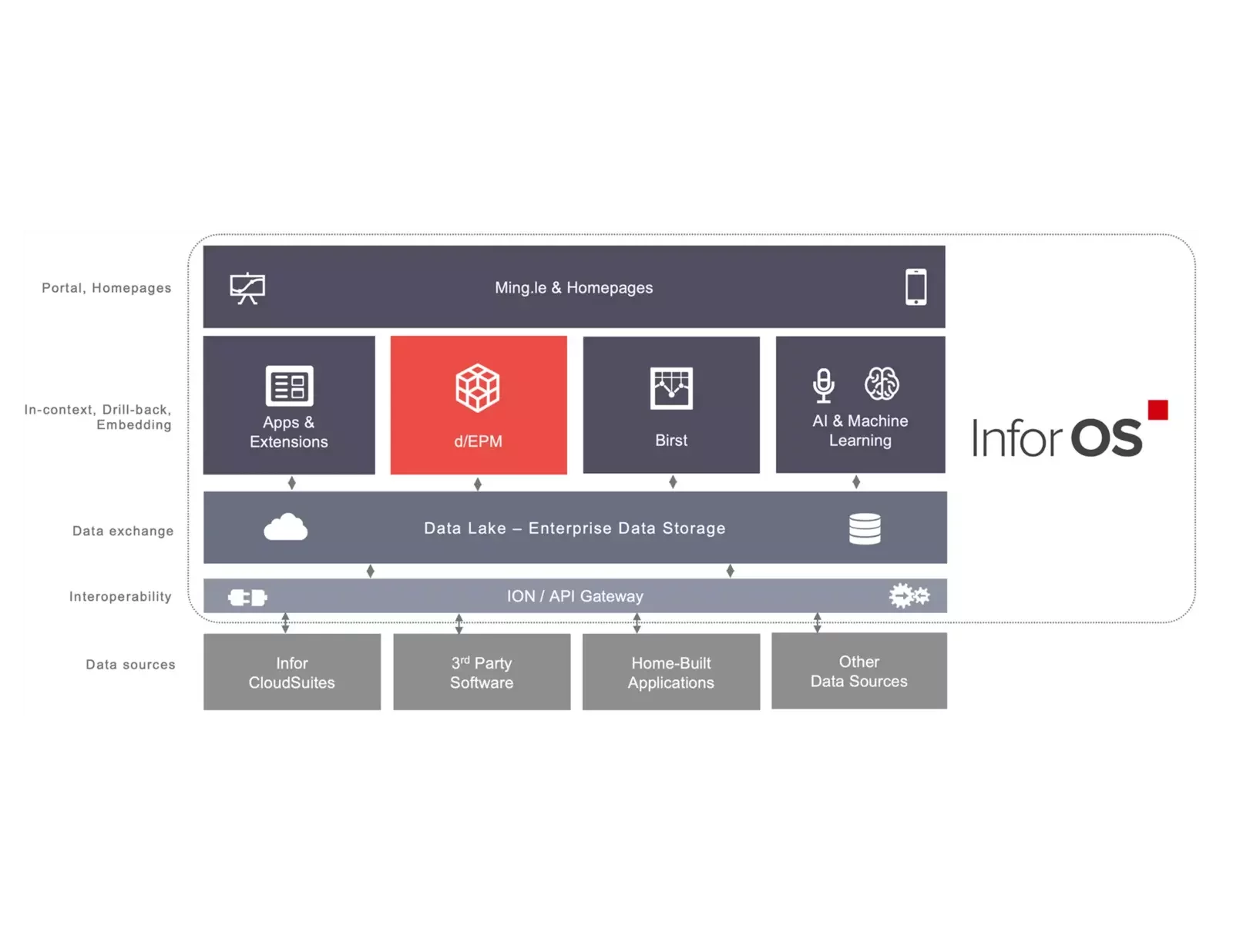
Implemented by ESS as an extension of the Infor ERP we already support.

20%
Higher financial process productivity reported by Infor EPM customers
30x
Faster roll-up model processing after upgrading
3 years
Running as a Leader in the Nucleus Research CPM Technology Value Matrix
50 years
ESS implementing manufacturing software in Canada and USA
Productivity and processing figures from Nucleus Research, Infor EPM Improves Financial Process Productivity by 20%, Document Y35, March 2024.
How long does your period-end close take?
Five business days is good. Ten is common. Fifteen means your board is making October decisions on August information.
The uncomfortable part is most of those extra days are spent with data collection, not even accounting. Exporting from each system, mapping accounts by hand, converting currency, eliminating the inter-company, finding a variance, starting again. Actual analysis gets whatever time is left.
Then budget season arrives. Templates go out to fourteen department managers. Four come back on time, two have changed the formulas, one sends a PDF. If board asks what the year looks like under a different assumptions and the answer is "give me two days" -- if this sounds familiar you are going to love what we have to show you.
What Infor EPM does?
Consolidate books that don't live the same system
Collect and consolidate results from single or multiple general ledgers, including systems your ERP doesn’t own — an acquired company, a foreign subsidiary, a legacy platform. Currency translation, intercompany eliminations, minority interests and joint ventures are handled by the consolidation engine, not by a spreadsheet.

Run the budget cycle as a process, not a document
Distribute templates, track who has submitted, lock versions, reconcile top-down targets against bottom-up submissions, and keep an audit trail of who changed which assumption and why. The cycle finishes because the system chases people, not because you do.

Re-forecast without rebuilding
Roll the forecast forward monthly or quarterly on a 12- or 18-month horizon. Previous versions stay intact, so you can measure how accurate your forecasting actually is — which is a conversation most finance teams have never been able to have. This information is critical to improving forecast accuracy over time.

Put a P&L against every scenario
Change an input and the full P&L, balance sheet and cash flow recalculate in memory, immediately. Model a 12% steel increase, a second shift, a tariff, an acquisition. Run as many versions as the question deserves instead of rationing them by how long each one takes to build.
Plan headcount and capital properly
Budget at position level, with vacancies, planned hires, merit increases and benefit-rate changes modelled against salary tables. Route capital requests through documentation and approval before purchase, and carry the resulting depreciation straight into next year’s plan.
Build your own reports
Formatted statutory reporting and self-service financial reporting, plus a native Excel add-in that writes back to the governed model. Finance changes the board pack without raising a ticket. Excel stays. The version drift doesn’t.
What does Infor EPM add to Infor CloudSuite Industrial?
An ERP is built to hold one authoritative record of what happened, company by company, and to defend it against change. A planning system is built to hold a dozen provisional versions of what might happen, across every company at once, and to change them hourly. Ask either one to do the other's job and a spreadsheet appears in the middle to cover the difference. Here's where that line falls, process by process.
| What you need | What CSI/Syteline does | What Infor EPM adds |
| Statuory consolidation | Consolidations and eliminations across companies inside CSI | A consolidation module with a journaling engine and a trial-balance mapping engine that ingests any GL |
| Multi-GAAP reporting | Reports on the basis the ledger is configured for | Parallel reporting under multiple accounting standards from one consolidated dataset |
| The budget cycle | Holds budget amounts and reports variance | Workflow built for how planning actually works — iteratively |
| Rolling forecast | An annual budget, re-entered when revised | A managed forecast process with prior versions retained |
| Scenario modelling | APS and S&OP model capacity, materials and schedule | An in-memory model that recalculates the financial statements the moment an assumption changes |
| Management reporting | Strong embedded operational dashboards and KPIs | Self-service financial reporting and an Excel add-in with write-back |
What it looks like when it works
After separating from its parent company, the corporate finance team at ORS Medco was left extracting data from multiple ERP systems and building consolidated balance sheets, income statements and cash-flow statements in Excel. Any user could adjust a figure, so data integrity was a standing concern.
After implementing Infor EPM, consolidations that had taken 15 business days were completed in five to seven — a 67% reduction — on an implementation delivered in three months. The team describes a push-button balance sheet and income statement, and analysis for the board that goes deeper than the statements they used to hand over.

Location
Deerfield, Illinois
Products
Infor CloudSuite
Infor EPM
Employees
1,100
50+ years in manufacturing software
We have been implementing manufacturing systems in Canada and USA for over five decades. We are an Infor Gold Channel Partner, and we already support Infor CloudSuite Industrial, Velocity Suite, CPQ, Field Service and VISUAL.
Our policy is no strings attached. If a conversation tells us Infor EPM isn’t the right answer for you, we will tell you that and explain why.
Questions finance teams ask us first
Start with a conversation
Thirty minutes with an ESS advisor. Bring your entity structure, how long your close takes, and what broke last budget season. We’ll tell you whether Infor EPM is the right answer — and if it isn’t, what is.
No strings attached.